Is this climate change-battered conifer migrating northward?

This web exclusive appeared on hcn.org Oct. 19, 2015:

Healthy yellow cedar from the stand on Douglas Island, near Juneau, AK.

We are high in the fold of a steep, boggy valley when my friend Sarah spots our quarry tucked amidst blueberry and dark hemlocks. The first yellow cedar is spindly, no more than four inches in diameter, with striated reddish bark and drooping feathery fronds that seem to fit the sodden, misty September day. We poke around and find another, then another; there are a couple hundred of the trees in this stand leaning over a cascading stream and spaced out along a hairpin bend in the trail that leads up to a Forest Service cabin above Juneau, Alaska.

Young as they are, they look a bit scraggly to my untrained eye, but they’re a small bright spot in an otherwise dark story: Yellow cedar, a culturally and commercially important tree prized for its strong, remarkably decay-resistant wood, has died in droves thanks to long-term climatic shifts, and will likely lose much more as human-induced warming advances. And yet here, the trees seem to be thriving. Scientists studying this and 14 other scattered, isolated stands around Juneau believe they may represent a leading edge of the tree’s migration northward into more favorable climes. The researchers hope the trees will yield clues on how best to conserve the species as temperatures climb. More…

Claustrophilia: Do wide-open lands bring us closer together?

Cover essay and photographs from the September 15, 2015 High Country News Books and Essays issue:

I can see a spark of tired panic in Jo’s eyes as they meet mine. Our narrow Purgon — a Russian-made UAZ van that resembles a jacked-up VW bus — is bursting with people. The rigid seats, which face each other like those in a diner booth, are crammed with butts, and our knees interlock like a human zipper. In the back, where baggage and boxes of supplies serve as yet more seats, two weathered old men hunch below the ceiling. In the front passenger seat, a woman settles on the lap of the standby driver.

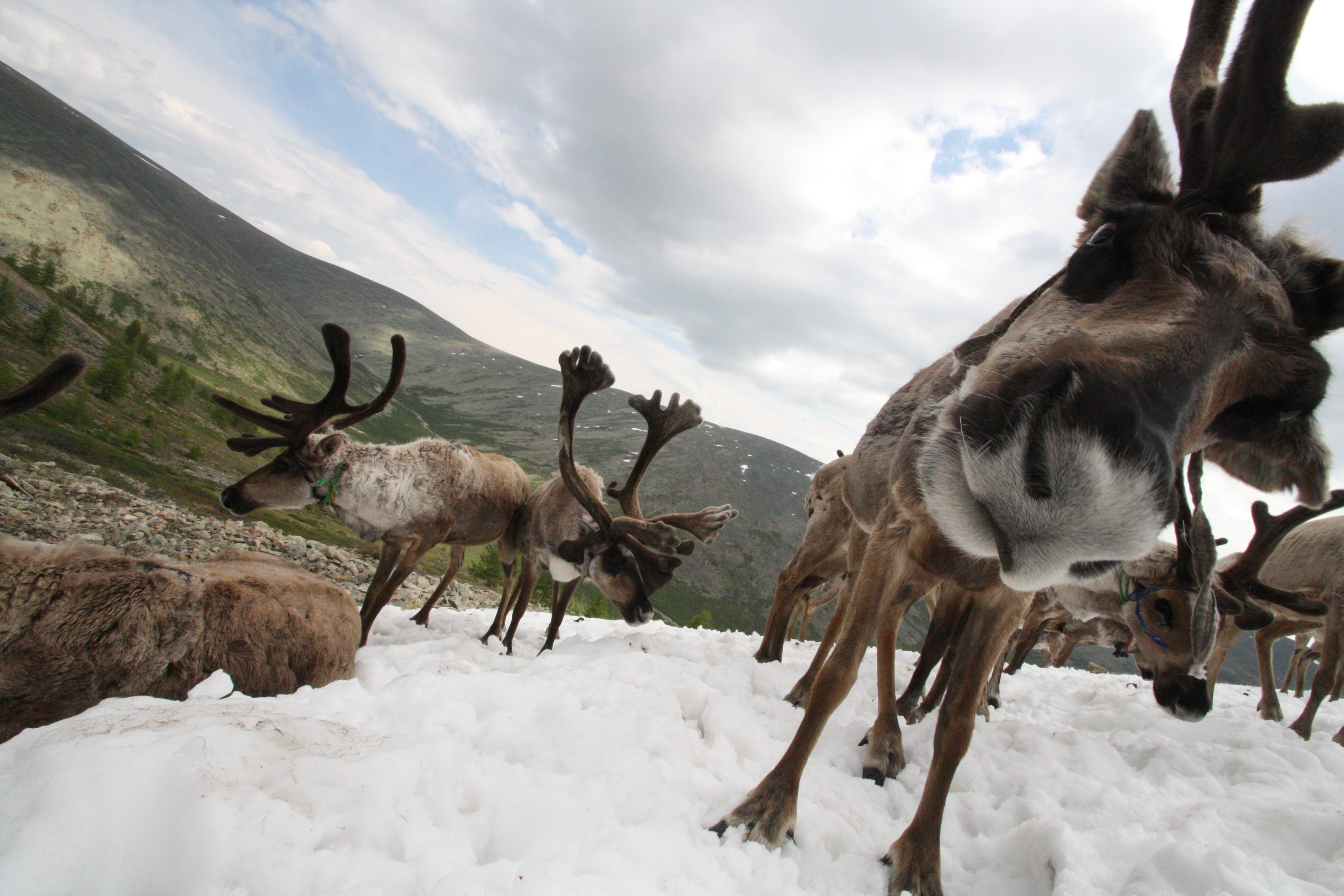
Dhuka reindeerAnd yet here we are, picking up another passenger. She looks like she weighs maybe 100 pounds soaking wet, but where will she fit? There’s a slim gap between Jo and her neighbor; the newcomer clambers over and wedges in sideways. Finally, finally, after six hours of waiting, the driver decides that we’re full. He grinds into gear and we chug free of Murun, Mongolia — capital of the country’s northernmost province — toward the remote village of Tsagaan Nuur, near the Russian border.

After 30 minutes of paved road, we veer abruptly onto a dirt two-track winding into the hills. Jo’s husband, Sean, who finished a Peace Corps assignment here in 2007, grins knowingly at Jo and me. “Jiiinkheeene,” he comments wryly, drawing out the Mongolian word. Jinkhene translates roughly as authentic, or old-school. But it can best be defined by what follows.

The Purgon bounces and shudders: The passengers brace arms against seats and each other’s knees, occasionally knocking heads. The Purgon grows steadily chillier: The passengers produce a laptop and memory stick and put together a compilation of Mongolian power ballads that the driver plays on repeat for the next 12 hours. The Purgon bogs in the mud: The passengers tumble out and push, sprinting in all directions when it lurches free at high speed. Through it all, everyone smiles, everyone laughs. There’s something almost tender about the ease with which strangers drowse on each others’ shoulders through the night. Shepherd slumps against meaty policeman; meaty policeman slumps against Sean; Sean, wincing, flattens his 6-foot-4-inch frame against the Purgon wall and my feet, which I had propped up to keep my knees from cramping.

The Mongolians are better at this than us.

In my early 20s, I was in a similar situation on a Greyhound bus between Kansas City and Denver. When the sleeping teenage girl next to me began drooling on my shoulder, I felt not tenderness but silent, half-homicidal rage.

Now, though, watching these strangers touch each other as casually as friends, I feel differently. Beyond the smeared windows stretches one of the most sparsely populated landscapes in the world. There are no fences, and little interrupts the gentle roll of the steppe besides patches of dark trees and congregations of plump sheep, yaks and horses. Felt roundhouses called gers — the traditional homes of pastoral nomads — appear now and then like white buttons stitched haphazardly onto rumpled green fabric. Sean has told us about the nomads’ generosity, how they will offer even unexpected visitors salted yak-milk tea, food, a bed. And I’ve read of the blizzards and subzero cold that pummel people here each winter. Maybe, I think, in all this beautiful, brutal vastness, a tiny enclosure that brings the world to a human scale is to be shared, not defended. How else would anyone survive in such a place? More…

How monk parakeets pick their battles

From Audubon.org, Sept. 10, 2015:

Remember middle school? Well . . . maybe you don’t want to. It turns out, humans aren’t the only ones who go through agonizing rounds of teasing and torment to find their place in the pack. Other primates and mammals create social hierarchies, too, as do fish, hermit crabs, and birds.

A study published today in PLOS Computational Biology shows how one species of bird forms its pecking orders. The researchers focused on the Monk Parakeet, a bright green South American native that has invaded parts of the southern and eastern United States over the last 40 years. More…

The Lesser Prairie-Chicken’s Spot on the Endangered Species List Is in Jeopardy

From Audubon.org, Sept. 4, 2015:

This year the Lesser Prairie-Chicken has faced a variety of attacks aimed at undoing its recent listing. Now, a lawsuit filed by the Permian Basin Petroleum Association and four New Mexico counties has succeeded in doing just that—at least temporarily.

On September 1, a U.S. district judge in Texas vacated the U.S. Fish and Wildlife Service’s decision to designate the Lesser Prairie-Chicken as threatened under the Endangered Species Act. His ruling stated that prior to listing, the agency failed to follow its own rules for gauging whether existing conservation programs could help stem the bird’s decline. “It’s just one more cut into the (agency’s) authority and the efficacy of the ESA,” says Karyn Stockdale, a senior advisor for the National Audubon Society and former director of Audubon New Mexico. More…

Bird v. bird: The complicated relationship between sage grouse and their avian predators

This feature appears on p.17-19 of the summer, 2015 issue of Western Confluence magazine:

Rancher Truman Julian says he has “a place in his heart” for greater sage grouse. A former wildlife biologist who still works land his family homesteaded near Kemmerer, Wyoming, around the turn of the 19th century, Julian has piped spring water to troughs at the dry edges of his private ground that he says benefit both sage grouse and livestock, and has installed special ramped screens the birds can climb to escape drowning
should they fall in.

Sage grouse, best known for males’ elaborate chest sac-puffing mating displays, need all the help they can get. Though the species persists in 11 western states and two Canadian provinces, it occupies
less than half its historic range; its numbers have fallen from historic estimates in the millions to as few as 200,000 today. Environmentalists, ranchers, government officials, sportsmen, scientists, and others have been rushing to bolster sage grouse populations in advance of the U.S. Fish and Wildlife Service’s decision this fall about whether the bird deserves special protections under the Endangered Species Act.

Because sage grouse declines stem from habitat fragmentation and loss, much of the recovery work has focused on protecting and restoring what’s left. But Julian wondered about another variable. “Over the last 10 to 15 years, we’ve built up a lot of ravens,” he says—whole fields black with them. “They raid everything. They kill our lambs. We had a rancher that lost five calves when ravens pecked into their hind-leg joints.” Local producers were increasingly calling on Wildlife Services—a federal agency tasked with managing human-wildlife conflicts—to poison ravens at calving and lambing time. Since ravens also gobble sage grouse eggs, Julian thought, why not ask researchers to look into whether the agency’s effort to protect livestock boosted local sage grouse as a side effect?

Jonathan Dinkins ended up with the project as a Utah State University PhD student in 2008. It’s normal for sage grouse to get eaten, says Dinkins, now a post-doc at University of Wyoming: they’re the natural prey of many different species, including ravens. But a raven boom could be contributing to a grouse bust. So in part, he would try to determine whether killing ravens actually helped more sage grouse nests succeed—that is, let more eggs hatch into chicks. It was a good opportunity, he says, “to look at management as it would occur.”

He also wanted to investigate whether avian predators in general—ravens and magpies as well as raptors that kill adult grouse—had broader impacts by affecting sage grouse behavior. Could they change how the birds used the landscape? Even make otherwise choice nesting and brooding habitat unusable by scaring sage grouse away?

In other words, could the mere threat of predation be eating away more of the habitat the already struggling grouse so desperately needed? More…

Climate showdown on the Willamette in Oregon

This web exclusive appeared July 31, 2015 on hcn.org:

It feels a bit like a picnic until the Coast Guard starts lunging at boats with a hooked metal pole.

IMG_2034

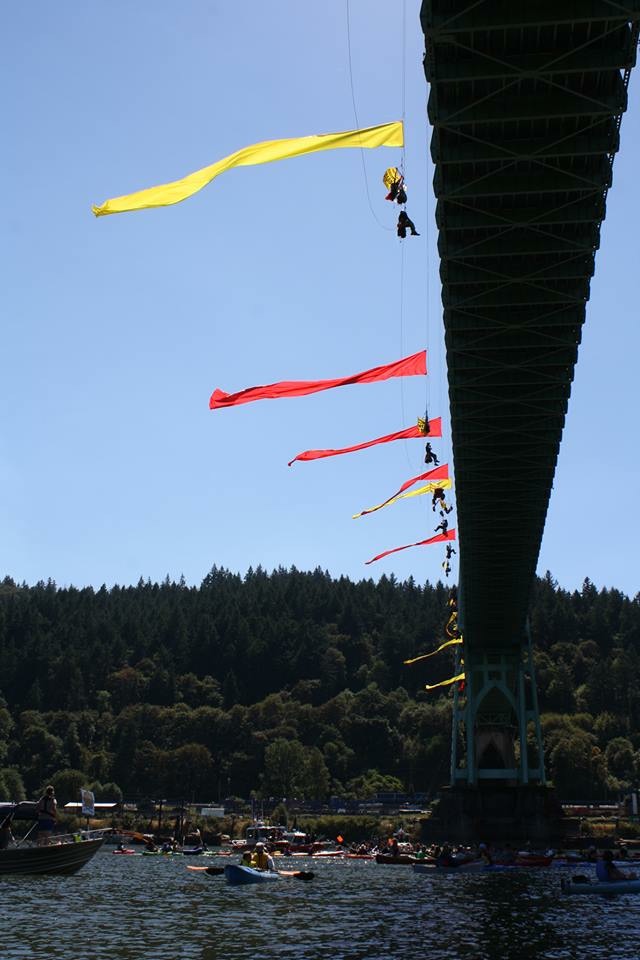
Dozens of colorful kayaks and canoes on Portland, Oregon’s Willamette River have been chasing shade under the St. Johns Bridge all day, their floppy-hatted passengers laughing and shouting slogans. People are crammed so tight on one side of a nearby floating dock that it lists to the side and water laps onto its boards. Some cheer, while others hoist speakers on lengths of PVC pipe, blasting the union anthem, “Which Side Are You On?”

Aside from a woman proudly holding a placard that reads: “Thank an oil company for all your protest/activist equipment,” it seems pretty clear which side most of the crowd favors. Thirteen Greenpeace activists dangle in climbing harnesses dozens of feet below the bridge. Their porta-ledges and stuffsacks, packed with days’ worth of supplies, are decorated with long red and yellow banners and giant signs reading “SHELL NO!” and “SAVE THE ARCTIC!” They and the kayaktivists, as the boaters have come to be called in recent months, are here to try to block the exit of the icebreaker MVS Fennica, which carries a key piece of safety equipment Royal Dutch Shell will need in order to move forward with oil drilling in the Chukchi Sea, off the north coast of Alaska. And at 7:30 that morning, they had already succeeded in turning it back once from the Columbia River, its gateway to the Pacific. “That was a little bit yay,” Sue Lenander, a 350.org member who came down from Seattle to join the flotilla, tells me. “But we can only fight them off for a day or two. It’s just a matter of time.” More…

Private-land camping startups offer alternative to public lands

This piece appeared in the July 20, 2015 print edition of High Country News:

On a sticky June evening, I pull onto the narrow shoulder of U.S. 30, 12 miles northwest of Portland, Oregon. Cars speed past my little Tacoma camper as I stroll down a short hill singed yellow by the heat wave. Nearly hidden from view behind rambunctious apple trees is Carey Haider’s two-story Quonset hut. Blackberry brambles creep along its edges, growing into a high thicket on the other side of the railroad tracks that run less than 20 paces from his back door. Beyond a towering power line, more mushroom clouds of greenery explode along the banks of the Multnomah Channel, blocking it from view.

IMG_7615

Haider, who sports a beard and suspenders, leads me past an overturned toilet to piles of sledgehammered sheetrock and siding. There, he points out a flat spot where I can park and lay my head for the night. “It looks like a meth house right now,” apologizes the 31-year-old graphic designer and photographer. He bought the property in December and is in the midst of overhauling it. “Whatever,” I tell him. “It beats KOA.”

I mean it, too, even though Haider’s planned noise-blocking fence, camp trailers and wood-fired hot tub aren’t yet in place. Finding a private, pleasant spot to sleep outdoors, especially near a city, can be tough. Try a pullout or parking lot, and you’ll often find a police flashlight in your face at 2 a.m. And state and national park and forest campgrounds overflow with generator-grinding RVs. Haider has signed up with a new Portland-based startup called LandApart to provide campers with another way: Access to private land via an online service. More…

Hot times usher in early Northwest wildfire season

This web exclusive appeared July 10, 2015 on hcn.org:

Portland, Oregon, has been hot lately. The kind of past-95 degrees hot that glues your clothes to your skin, with multi-day “Excessive Heat Warnings” following on each other’s heels. Several Northwestern communities broke all time heat records late last month and temperatures across the region hovered 10 to 15 degrees above average. A weather map was so garish with red, pink and yellow that one TV meteorologist compared it to a Grateful Dead T-shirt.

So when the long Fourth of July weekend rolled around, some friends and I sought relief in a basin of cold blue lakes high in Washington’s central Cascades. The heat’s signature was everywhere along the Columbia River as we set out on Thursday evening. The grassy hills stepping back from the Gorge’s basalt cliffs were scorched nearly white. As we came around a bend in Highway 97, we saw that they were scorched black as well, where the bright fingers of a grassfire picked their way up through a forest of wind turbines. It took an hour to detour around the blaze. When we finally turned back onto northbound 97, we broke through an endless line of stopped cars and semis awaiting clearance to head south — their headlights stretching across the darkness like a line of flame themselves.

The Junction Fire — which had consumed 2,100 acres by Friday — was one of 1,425 fires that have started in Oregon and Washington so far this season, about double the average for this time of year, says John Saltenberger, fire weather program manager at the Northwest Interagency Coordination Center. “We’re already seeing fire index values (based on heat, humidity, wind and precipitation) you’d typically see in late August.” More…

The sage grouse two-step: Massive federal sage grouse conservation plans strike a delicate balance.

This piece appeared in the June 22, 2015 print edition of High Country News:

Northern spotted owls are white-and-brown tree dwellers with sprays of feathers between their eyes. Greater sage grouse are football-sized ground-strutters, whose males flaunt yellow chest sacs during mating season. The owls nest in drippy old-growth Northwest forests; the sage grouse, beneath the dry, silvery fronds of their namesake shrub. When spotted owls were blamed for shutting down the Northwest’s timber industry in the ’80s and ’90s, bumper stickers appeared with slogans like “I love spotted owls … fried.” And though people actually eat sage grouse, their notoriously bitter taste has perhaps kept them off the tongue-in-cheek menu.

The two birds couldn’t be more different, but they’re often compared because their declines catalyzed massive, controversial federal interventions. A few years after the owl was listed under the Endangered Species Act, the Clinton administration hammered out the nation’s first-ever landscape-scale attempt to manage for ecosystem health. Crafted in a mere 90 days under intense pressure to end years-long wars over logging’s environmental toll, the Northwest Forest Plan sought to balance the industry with habitat protections across 24 million federal acres. But timber harvests proved much lower than promised, leaving local communities reeling and making the spotted owl a magnet for ESA bashers.

Critics will have an even better target if the U.S. Fish and Wildlife Service lists the grouse this year: The bird shares its vast range with powerful industries like oil and gas. To avoid a listing, in late May Interior Secretary Sally Jewell unveiled 14 plans that protect 66 million acres of grouse habitat on Bureau of Land Management and Forest Service lands across 10 states. Unlike the Northwest Forest Plan, though, the sage grouse process has been collaborative from the get-go. The resulting strategy walks a political tightrope, building on states’ existing efforts to conserve the bird, while imposing the consistent, range-wide safeguards needed to convince Fish and Wildlife that additional protections are unnecessary.

“We’re trying to put together something that works for the bird and provides flexibility for sustainable economic development,” says Jim Lyons, Interior’s deputy assistant secretary for lands and minerals, who has helped coordinate the planning since 2013 and did the same for the Northwest Forest Plan. But if things skew too far in either direction, the whole endeavor may collapse. More…

Utah vastly overstating future water shortages

This web exclusive appeared May 7, 2015, on hcn.org:

Utah’s Division of Water Resources has painted a bleak picture for the state’s hydrological future. Even if water use is cut through conservation, officials project that demand will outstrip available supplies by 2040, as the population nearly doubles to 6 million people by 2060. A whopping $33 billion in upgrades, maintenance of existing water systems and development of new supplies will be needed to make up the shortfall.

Set against a backdrop of a few difficult drought years, reservoirs dropping and some communities overpumping aquifers, the scenario can seem a pretty compelling argument for two massive and controversial water projects that the state wants to build: A 6-foot-diameter, 140-mile-long pipeline that would allow Utah to draw its remaining share of Colorado River water from Lake Powell and pump it to Kane and Washington Counties; and a new dam on the Bear River system, which feeds into the Great Salt Lake, that would supply 220,000 acre-feet of water to surrounding communities.

Trouble is, that scenario may be flat wrong, or at the very least overstated. More…