L.A. is here to stay

This essay introduced a special double issue of High Country News, published January 20, 2014, on urban sustainability that I assembled and edited

Paul set his mug of wine down and glowered at me over his glasses. Los Angeles? Why would any magazine editor include Los Angeles in a special issue on environmental sustainability?

My friend and former professor had good reason to ask. The camper Paul calls home, where I had stopped for dinner that October night, is parked on the upper edge of the sprawling sage-furred desert of California’s Owens Valley. In the early 1900s, L.A. drained the water from Owens Lake, about 80 miles south of here, to feed its own booming growth and glitz. Its thirst left behind toxic dust storms and a bitter grudge among the area’s rural residents.

I encountered similar sentiments when I told others about the stories of urban environmental innovation I was editing for High Country News‘ annual Future issue. Las Vegas? A city like that in a desert is a crime against nature, an environmentalist friend scoffed to me at the local brewery. Phoenix? That, too. Even our student-writing contest got a rise: “While I am very interested in writing an essay that would further our efforts to achieve sustainability in Western Colorado, there is one big problem,” wrote one prospective participant. “A modern industrial society will NEVER be sustainable (here). Virtually all our essential supplies are imported from outside our area.” More…

If the gas industry wants enviro cred, it should embrace methane regulation

This web exclusive appeared on hcn.org on January 15, 2014

Shift more of the nation off coal-powered electricity and onto that supplied by natural gas, and what do you get? A significant reduction in the carbon emissions driving the alarming climatic shifts we already experience in our daily lives. That’s the theory anyway, based on the fact that natural gas produces about half the carbon dioxide that coal does when burned. And if you put aside concerns about drilling’s impacts to air and water quality, it’s an important one, since this electricity switch may account for a significant portion of the overall decrease in U.S. greenhouse gas releases that’s occurred over the last few years.

Trouble is, the climate benefits of natural gas hinge on just how much is leaking from the wells, pipelines, compressor stations and other infrastructure used to extract and deliver the fuel. But due to the paucity of comprehensive data, the large margins of error in the findings and the wildly disparate conclusions of various researchers, nobody’s quite sure what the percentage is. Methane, natural gas’s primary component, is a vastly more potent greenhouse gas than CO2, though more short-lived; as Sarah Keller reported for High Country News last summer, as little as 3 percent loss could cancel out the emissions reductions achieved by moving from coal to gas. Recent studies certainly don’t stoke confidence. One based on thousands of actual air samples, published in the The Proceedings of the National Academy of Sciences in November, concluded that U.S. methane emissions were actually 1.5 times higher than previously thought, and that those for the oil and gas industry in Kansas, Oklahoma and Texas were 5 times higher, reports The New York Times.


Given this, you’d think the industry would be falling all over itself to do away with leaks and thus help ensure its place in the U.S. energy pantheon long into the future, as well as improve its dismal public image. More…

The Blue Window

This essay appeared in the August 14, 2013 issue of High Country News

IMG_3462“Buy this book and read it on the plane (!)”

This was David’s advice to me for our upcoming expedition to Alaska’s Harding Icefield, emailed along with a link to Glacier Mountaineering: An Illustrated Guide to Glacier Travel and Crevasse Rescue.

I am no stranger to mountains, having grown up in Colorado and spent several seasons building trail, backpacking, doing biological research and writing in the state’s stretch of the Rockies. But glaciers were a mystery to me — and the Harding is the largest icefield in the United States. Together with the more than 30 glaciers that flow from it, it covers 700 square miles of the Kenai Peninsula and may be a mile thick in places. A Google search yielded pictures that were both alluring and bowel-watering, but no travel accounts. What, I wondered, had I gotten myself into when I agreed to accompany author Craig Childs, David Stevenson, John McInerney and adventure photographer James Q Martin on a research trip for Craig’s book exploring ancient human migration?

I wrote back to David, an experienced mountaineer: Should I do anything else to prepare? Probably not, he replied. Then, “Full disclosure: McInerney says that my default answer is, ‘It will be fine.’ When he hears me say that, he interprets it as, ‘Stevenson is a lunatic, who has a death wish.’ “

Great, I thought, and bought the book. More…

The Fossil Record: How my family found a home in the West

3-page feature from High Country News’ October 16, 2012 Books and Essays issue

IMG_1677When I was a kid, I sometimes wished that my family went on normal vacations.

Normal was what my elementary and middle-school classmates did over spring and summer break, flying to wave-kissed beaches or hitting flashy amusement parks. Not my family: My parents would load my two half-sisters, my brother and me into a big blue Dodge van with finicky air-conditioning and drive us hundreds of sweaty miles to exciting destinations like Lusk and New Castle, Wyo., Broadus and Miles City, Mont.

Amusement parks, as far as they were concerned, held nothing but crowds, noise and cheap gewgaws, and Mom, whose fair skin burned easily, was not fond of prancing about in a bathing suit. But the broad and sparsely populated reaches of eastern Wyoming and Montana offered clear, dry air, sweeping skies, and an intoxicating sense of freedom. Best of all, their badlands and breaks were scattered with the remains of the late Cretaceous — mineralized seashells that in life, 100 to 65 million years ago, cradled tentacled creatures in the dark of an inland sea.

Decked out in long-sleeved shirts and pants, broad-brimmed cloth hats and boxy over-the-spectacles sunglasses, Mom and Dad led us across this dry country, teaching us the difference between placenticeras and scaphites, baculites and didymoceras.

To sweeten the deal, they booked rooms in motels with swimming pools, and when we were older, allowed us to bring friends who were curious (or brave) enough to join us in the baking expanses. Even so, we kids stopped going in late high school, more thrilled by the prospect of a parent-free house. With barter and bribe no longer necessary, Mom and Dad could finally pursue their obsession untroubled by our demands for normalcy.

So when, at 31, I ask whether I might tag along on a weeklong fossil trip near Casper, Dad pauses.

“How long do you think you’ll join us for?” he asks.

“A day or two?” I suggest.

“Oh, good,” he says. “We wouldn’t want you to cramp our style.”

More…

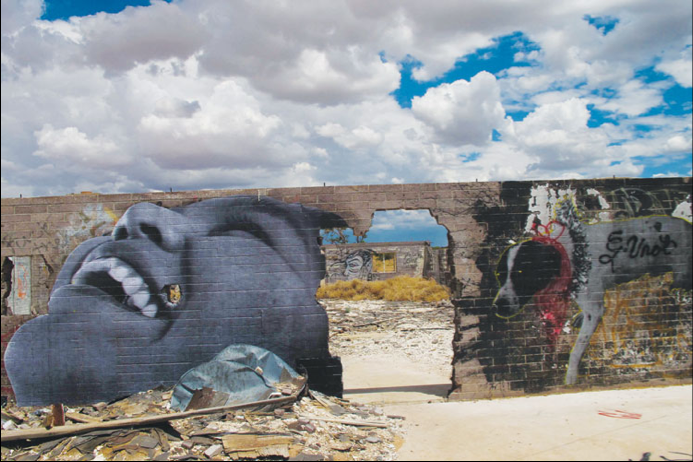
Street artist Jetsonorama tries a new kind of healing in Navajoland

This story originally appeared in the March 23, 2012 print edition of High Country News:

In 1991, a young doctor delivered a baby Navajo girl in his backseat. A man had pounded on his door earlier that evening, his girlfriend in labor and his truck too slow for the 50-mile trip to the Tuba City, Ariz., hospital. The doctor loaded the woman into his own car, thinking they could make it. The baby, whom we’ll call Emily, had other ideas.

Screen shot 2014-09-05 at 2.25.54 PMSixteen years later, Emily was in treatment for meth abuse. In 2009, the doctor visited the girl in jail, where she was serving time for drunk driving. Her drinking had worsened after her mother’s death, she told him. But she looked hopeful: In nine days she’d be out. Then, she promised, she’d stay clean.

The doctor was at a turning point of his own. He told the girl that he had started moonlighting as a street artist under the pseudonym Jetsonorama, which he prefers we use in print. It was a different sort of healing project.

“(Emily’s) story is very typical here on the Rez,” Jetsonorama says now from his home in Inscription House, in northeastern Arizona, where he’s the only permanent physician at the Indian Health Service’s clinic. “The recidivism rate is quite high, the teen pregnancy rate is quite high. There’s an epidemic of methamphetamine use. In some ways, there’s not a lot of hope. I’m trying to present especially positive images of the Navajo on the reservation — to inject an element of beauty, an element of surprise and an element, hopefully, of pride.”

He draws photos from his portfolio, enlarges them in two-by-two-foot sections at a print shop, cuts them out on his kitchen floor, and uses wheatpaste — a mixture of Bluebird flour (favored by Navajo grandmas), sugar and water — to attach them, piece by piece, to ruined buildings, roadside jewelry kiosks, market walls, water tanks. Any surface will do, as long as it’s big enough for his subjects to stand out against the vast stretch of desert between Monument Valley and the Grand Canyon, where tourists race through at 70 miles per hour. The images are monolithic, visually arresting and biodegradable — echoes of human life on the landscape, almost as fleeting in the wind and weather as the moments captured in the photos themselves. More…