Avalanches weren’t – and aren’t – only a backcountry threat

This web exclusive appeared on hcn.org on March 11, 2014

In the handful of times I’ve visited Missoula, Montana, the grassy slopes of neighboring L- and M-emblazoned Mounts Jumbo and Sentinel have never looked any more threatening to me than the hogbacked foothills that yaw out of the ground west of Boulder, Colorado, my hometown. Velvety, yes. Curved like a set of relaxed shoulders, yes. Welcomingly draped in the low-angled sun of late afternoon, yes. Avalanche death zone? Not so much.

But on Feb. 28, an unusually intense blizzard snapped a wet quilt of deep snow over the valley, rumpling it into drifts and slabs with gusts up to 50 mph. Atop Jumbo and Sentinel, as well as the surrounding mountains, a weak crust of ice that unseasonably warm weather had glazed over the existing snowpack earlier in the week strained beneath the weight. When a group of snowboarders started down Jumbo — closed since November to protect a wintering elk herd – around 4 p.m., that strain released spectacularly. A large slab avalanche ran from near the mountain’s peak almost 1,300 vertical feet into a neighborhood on the valley floor, obliterating a two-story house, damaging several other homes and vehicles, and worst of all, burying three people. More…

L.A. is here to stay

This essay introduced a special double issue of High Country News, published January 20, 2014, on urban sustainability that I assembled and edited

Paul set his mug of wine down and glowered at me over his glasses. Los Angeles? Why would any magazine editor include Los Angeles in a special issue on environmental sustainability?

My friend and former professor had good reason to ask. The camper Paul calls home, where I had stopped for dinner that October night, is parked on the upper edge of the sprawling sage-furred desert of California’s Owens Valley. In the early 1900s, L.A. drained the water from Owens Lake, about 80 miles south of here, to feed its own booming growth and glitz. Its thirst left behind toxic dust storms and a bitter grudge among the area’s rural residents.

I encountered similar sentiments when I told others about the stories of urban environmental innovation I was editing for High Country News‘ annual Future issue. Las Vegas? A city like that in a desert is a crime against nature, an environmentalist friend scoffed to me at the local brewery. Phoenix? That, too. Even our student-writing contest got a rise: “While I am very interested in writing an essay that would further our efforts to achieve sustainability in Western Colorado, there is one big problem,” wrote one prospective participant. “A modern industrial society will NEVER be sustainable (here). Virtually all our essential supplies are imported from outside our area.” More…

If the gas industry wants enviro cred, it should embrace methane regulation

This web exclusive appeared on hcn.org on January 15, 2014

Shift more of the nation off coal-powered electricity and onto that supplied by natural gas, and what do you get? A significant reduction in the carbon emissions driving the alarming climatic shifts we already experience in our daily lives. That’s the theory anyway, based on the fact that natural gas produces about half the carbon dioxide that coal does when burned. And if you put aside concerns about drilling’s impacts to air and water quality, it’s an important one, since this electricity switch may account for a significant portion of the overall decrease in U.S. greenhouse gas releases that’s occurred over the last few years.

Trouble is, the climate benefits of natural gas hinge on just how much is leaking from the wells, pipelines, compressor stations and other infrastructure used to extract and deliver the fuel. But due to the paucity of comprehensive data, the large margins of error in the findings and the wildly disparate conclusions of various researchers, nobody’s quite sure what the percentage is. Methane, natural gas’s primary component, is a vastly more potent greenhouse gas than CO2, though more short-lived; as Sarah Keller reported for High Country News last summer, as little as 3 percent loss could cancel out the emissions reductions achieved by moving from coal to gas. Recent studies certainly don’t stoke confidence. One based on thousands of actual air samples, published in the The Proceedings of the National Academy of Sciences in November, concluded that U.S. methane emissions were actually 1.5 times higher than previously thought, and that those for the oil and gas industry in Kansas, Oklahoma and Texas were 5 times higher, reports The New York Times.


Given this, you’d think the industry would be falling all over itself to do away with leaks and thus help ensure its place in the U.S. energy pantheon long into the future, as well as improve its dismal public image. More…

Street artist Jetsonorama tries a new kind of healing in Navajoland

This story originally appeared in the March 23, 2012 print edition of High Country News:

In 1991, a young doctor delivered a baby Navajo girl in his backseat. A man had pounded on his door earlier that evening, his girlfriend in labor and his truck too slow for the 50-mile trip to the Tuba City, Ariz., hospital. The doctor loaded the woman into his own car, thinking they could make it. The baby, whom we’ll call Emily, had other ideas.

Screen shot 2014-09-05 at 2.25.54 PMSixteen years later, Emily was in treatment for meth abuse. In 2009, the doctor visited the girl in jail, where she was serving time for drunk driving. Her drinking had worsened after her mother’s death, she told him. But she looked hopeful: In nine days she’d be out. Then, she promised, she’d stay clean.

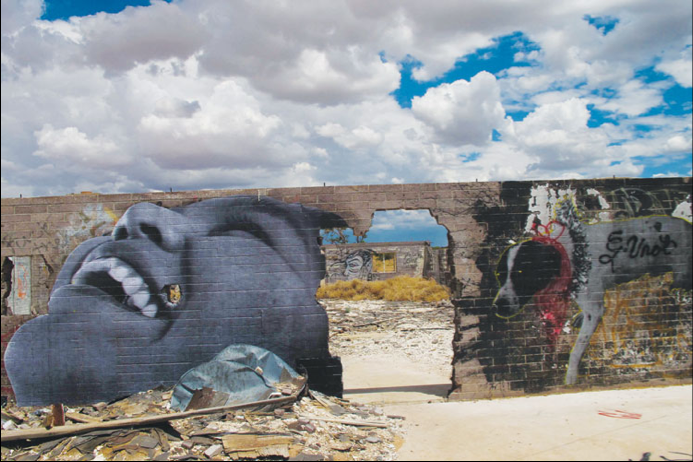
The doctor was at a turning point of his own. He told the girl that he had started moonlighting as a street artist under the pseudonym Jetsonorama, which he prefers we use in print. It was a different sort of healing project.

“(Emily’s) story is very typical here on the Rez,” Jetsonorama says now from his home in Inscription House, in northeastern Arizona, where he’s the only permanent physician at the Indian Health Service’s clinic. “The recidivism rate is quite high, the teen pregnancy rate is quite high. There’s an epidemic of methamphetamine use. In some ways, there’s not a lot of hope. I’m trying to present especially positive images of the Navajo on the reservation — to inject an element of beauty, an element of surprise and an element, hopefully, of pride.”

He draws photos from his portfolio, enlarges them in two-by-two-foot sections at a print shop, cuts them out on his kitchen floor, and uses wheatpaste — a mixture of Bluebird flour (favored by Navajo grandmas), sugar and water — to attach them, piece by piece, to ruined buildings, roadside jewelry kiosks, market walls, water tanks. Any surface will do, as long as it’s big enough for his subjects to stand out against the vast stretch of desert between Monument Valley and the Grand Canyon, where tourists race through at 70 miles per hour. The images are monolithic, visually arresting and biodegradable — echoes of human life on the landscape, almost as fleeting in the wind and weather as the moments captured in the photos themselves. More…