Klamath will be the biggest dam removal project in history

This story appeared on NationalGeographic.com on April 11, 2016.

Glen Canyon Dam began its life with an explosion. Congress authorized the dam’s construction on this day in 1956, and about seven months later, then-president Dwight D. Eisenhower pressed a telegraph key in the Oval Office, sending the signal to blast a string of dynamite wedged in the side of a sinuous canyon. Boulders sprayed through the air at Arizona’s northern border, and workers began drilling a tunnel to temporarily redirect the flow of the Colorado River while they built the base of the dam.

Monstrous Lake Powell filled in behind the 710-foot dam, drowning Glen Canyon’s otherworldly red-rock amphitheaters and slot canyons under its silty depths.

These days, when dams in the U.S. make news, it’s often concrete getting blasted, not bedrock. And last week, the biggest dam-removal project in history got a crucial endorsement.

Federal officials, the states of Oregon and California, and the utility PacifiCorp signed a pair of agreements opening the way for removal of a whopping four hydroelectric dams on the Klamath River, which flows from Oregon through Northern California. More…


Flying Forests

This post appeared at The Last Word on Nothing on April 8, 2016

Flying forest headerCorvids are a wonderful genre of beast.

I was reminded of this fact not long ago when, biking back home across southeast Portland from the waterfront, a veritable river of crows began streaming overhead. Thousands of them blurred and bobbed and circled each other in a stuttering current from east to west. This current eddied over warehouses. Spilled over parking lots. Formed a recirculation hole over the freeway, then fanned into a delta and out of sight beyond the skyscrapers of downtown. Corvid biologist John Marzluff later told me that the crows were likely heading for a communal roost to settle for the night. There’s one in his home city of Seattle that’s 15,000 strong.

Besides coalescing into this sort of breathtaking “murdermuration,” as I’ve decided to call it, crows recognize their dead, understand analogies, and one species, the New Caledonian crow, even makes its own tools.

Yet while crows and ravens get most of the attention, smaller members of the corvid family like jays and nutcrackers are out in the world busily building and rebuilding forests. Not on purpose, of course, but through a behavior charmingly called “scatter hoarding,” which basically involves stashing seeds around in various places for later devourment. (The same phrase could easily describe the way I distribute books throughout my house.) More…

New map shows rise in human-caused earthquake risk

This piece appeared on nationalgeographic.com on March 28, 2016:

Most people associate Oklahoma with weather-related disasters: tornado outbreaks, massive wildfiresLawrence of Arabia-style dust stormstumbleweed maelstroms. But thanks to oil and gas wastewater injected deep into the ground, parts of the state can now also claim the dubious distinction of being among the most likely places in the United States to experience a damaging earthquake in 2016.

On Monday, the U.S. Geological Survey unveiled an earthquake hazard forecast for the central and eastern parts of the country that for the first time includes human-caused quakes, referred to in technical parlance as “induced seismicity.” The report suggests that seven million people in parts of Oklahoma, Kansas, Colorado, New Mexico, Texas, and Arkansas face increased risks from human-induced earthquakes in the next year.

The risks appear most widespread and significant in north-central Oklahoma and a tiny sliver of southern Kansas, where a large area has a 5 to 12 percent chance per year of an earthquake that can cause buildings to crack and, in rare cases, collapse. That’s comparable to risks in parts of more seismically famous California, USGS scientists said at a press conference on Monday. More…

Oregon’s Trail through Time: How do you protect a historic artifact from the development it catalyzed?

IMG_8067This feature appeared in the March 7, 2016 special travel issue of High Country News:

Ignore the cold that stiffens your fingers this blustery November day. Ignore the snow atop the distant mountains and the seed-flecked mud that weights your boots. Forget the Jeep Cherokee you came in. None of that was here, in eastern Oregon, in late summer when they crossed.

“You’ve gotta pretend,” says Gail Carbiener, “that it’s 100 degrees.”

I close my eyes. Beneath my feet are the ruts of the Oregon Trail, left by thousands of covered wagons that settlers used to haul belongings from Missouri to the valleys beyond the Cascades, back during the 1840s, ’50s and ’60s. Even then, the route wasn’t new: Fur trappers and missionaries used it, and so, for millennia, did Native peoples.

Today, it’s the designated Oregon National Historic Trail, administered by the National Park Service and mostly visited by history enthusiasts like Carbiener and his wife, Muriel. This particular stretch, northwest of Ontario, Oregon, was a brutally dry 25 miles between the algae-choked Malheur River and a final crossing of the Snake River called Farewell Bend. I conjure creaking leather, plodding livestock, and sunburnt families on foot. It’s not easy: The ruts look more like an eroded ditch grown over with sagebrush. I can faintly hear traffic on Interstate 84, out of sight beyond a hill that fails to conceal a cellphone tower.

The visual intrusion makes 81-year-old Carbiener scowl beneath his John Deere ball cap, but otherwise, the white-grassed hills appear mostly unchanged since the 19th century. That’s why the Carbieners so love this spot, called Birch Creek. Those early travelers “would talk about coming up to a ridge, and as far as the eye could see, they saw wagons,” Gail Carbiener continues. “And so the dust here was unbelievable. The diaries would say that it was so thick, we can’t see the oxen in front of the wagon.”

To complete the scene, I glance at Muriel Carbiener. She performs living history at the High Desert Museum in Bend, where the couple lives, and today, she’s in character. A bonnet covers her close-cropped hair and a floral-print dress hangs to her ankles, cinched with a slightly tattered apron. “And of course there’s a corset,” the diminutive 79-year-old laughs, to “keep the girls in. Do you want to walk 2,000 miles without any support?” More…

The day I tried to love ticks

6368332077_9e5a91f7c1_z

This post appeared in The Last Word on Nothing on February 26, 2016.

There’s a certain category of mundane but distinctly unpleasant discovery: The blueberries you just mixed in your oatmeal explode mold into your mouth at 6 a.m. You read that Donald Trump won the Nevada Republican caucuses. You roll over in bed to find a tick lodged midriff-deep in your shoulder, wiggling about with a tenacity that suggests she plans to spelunk all the way through to your lungs.

“Fortuitously, the antibiotic you take prophylactically for Lyme disease is also the one you take to treat Chlamydia,” the doctor tells me cheerfully a day later when he checks the bruised and swollen bite and gives me a prescription. I stare at him, wondering why he thinks I need this information. It’s unlikely that I’ve got Lyme. Though local incidence is going up, Oregon saw only 44 reported cases in 2014 and Washington generally gets fewer than 30 a year – with just zero to three stemming from local ticks. But the fact that odds are in my favor fails to cheer me as I pluck tick after ever-more-engorged tick from my dog over the next several days. They’re small and hide well in her fur, so unless they pop out of her ears and stroll calmly across her face (some do) I can’t seem to find them until they’re attached and on their way to becoming fat and shiny as coffee beans.

Their emergence is, of course, just as much a sign of spring as the lovely purple grass widows my friend Roger and I had been out looking for when tickmageddon started last Saturday. By tick 10, I started to wonder: Aside from their reputation for transmitting more diseases than any other blood-sucking arthropod, why shouldn’t I find a way to appreciate ticks, too – from a safe distance away? Maybe I could even learn to love them a little bit. Continue reading The day I tried to love ticks

Pretend this Environmental Impact Statement is a national park

This post appeared on The Last Word on Nothing on Jan. 22, 2016

FullSizeRender-3

Behold, the majestic white cliffs. They form ghostly canyons that stretch into forbidding fog. Swallows build mud-daub nests on their walls. Falcons dive from their precipices to eat the swallows. Some say people have vanished here without trace, back during the first days of exploration.

Limestone? you ask. The incised and sculpted leavings of an ancient seabed?

No. Paper. Thousands of pages of stacked paper. But really, we’re not concerned about those cliffs. We must look beyond them: The landscape we’re here to “see” is contained therein, and it looks nothing like this one. Continue reading Pretend this Environmental Impact Statement is a national park

What a dead blue whale can teach us about the ocean — and ourselves

This article appeared on Smithsonianmag.com Nov. 18, 2015:

Standing on the blustery beach, Bruce Mate wears a camo slicker, green bibs, a tidy white beard and a somber expression. While Mate’s getup suggests a typical day in the field for a marine mammalogist, the box of latex gloves and bottle of chainsaw lubricating oil under his arm hint at this morning’s unusual task.

The behemoth corpse stranded here the previous Monday, November 2. As far as Mate knows, it’s the first recorded case of a blue whale washing up on the Oregon coast. The creatures are rare; perhaps 2,500 ply the eastern north Pacific, making up between 10 and 25 percent of the global population.

Because blue whales range over vast distances, they tend to sink far from shore when they die, seeding and sustaining a diverse ecosystem of creatures on the seafloor. For a carcass to drift within reach of human experts is the scientific equivalent of that bonanza, known as whale fall. A day after the stranding, Mate, who directs OSU’s Marine Mammal Institute in Newport, and OSU stranding coordinator Jim Rice were on scene with a mission: Extract the giant skeleton for public display. More…

Enjoy These Gorgeous Bird Pics—Hey, It’s Good for Conservation

A conversation with conservation photographer Gerrit Vyn that ran on Audubon.org November 16, 2015.

When photographer Gerrit Vyn talks about birds, he throws around adjectives like “insane,” and “incredible,” and “amazingly insanely incredible.” As a kid, he fixated on reptiles, then butterflies, then small mammals. But it was a White-breasted Nuthatch and a Tufted Titmouse that helped him get hooked on birds. That was when he was 12; now, 33 years later, Vyn spends around 150 days a year traveling all over the world for his avian obsession. He folds his 6-feet 8-inch frame into cramped airplane seats, and hunches in tiny blinds for hours, all in the name of conservation photography.

For the past 11 years Vyn has been a media producer for the Cornell Lab of Ornithology, filming, photographing, and recording audio from birds. This October the lab celebrated its 100th anniversary by releasing The Living Bird, a coffee-table collection of Vyn’s portraits of North American birds. (See some selections below.) The book explores the lives of birds, what they mean to people, and how humans can help save them from environmental disaster. More…

Can drilling and recreation get along in Moab, Utah?

This article appeared in the Nov. 9, 2015 print edition of High Country News.

Neal Clark has been watching his feet a lot this fall day. The young environmental lawyer chose flipflops for today’s tour of the Utah desert with the blithe self-assurance of someone comfortable outdoors. Remarkably, he’s stumbled into thorns only once. Now, he cautiously threads a gap between banks of cryptobiotic crust. The castle-like colonies of microorganisms anchor the thin topsoil; no conscientious environmentalist would crush them. But Clark pauses: Just ahead, an oil rig towers on a patch of earth scraped bare to accommodate trucks and equipment. “There’s something ironic about tiptoeing around crust next to something like this,” he says wryly.

That incongruity stretches far beyond this spot. Clark, who works for the Southern Utah Wilderness Alliance, is pointing out Bureau of Land Management parcels that are being developed for oil and gas near Canyonlands National Park, Dead Horse Point State Park and some of the other scenic areas that have made nearby Moab an outdoor recreation mecca. More…

The masks we wear

This is crossposted from The Last Word on Nothing, a science writing blog where I just became a regular contributor!

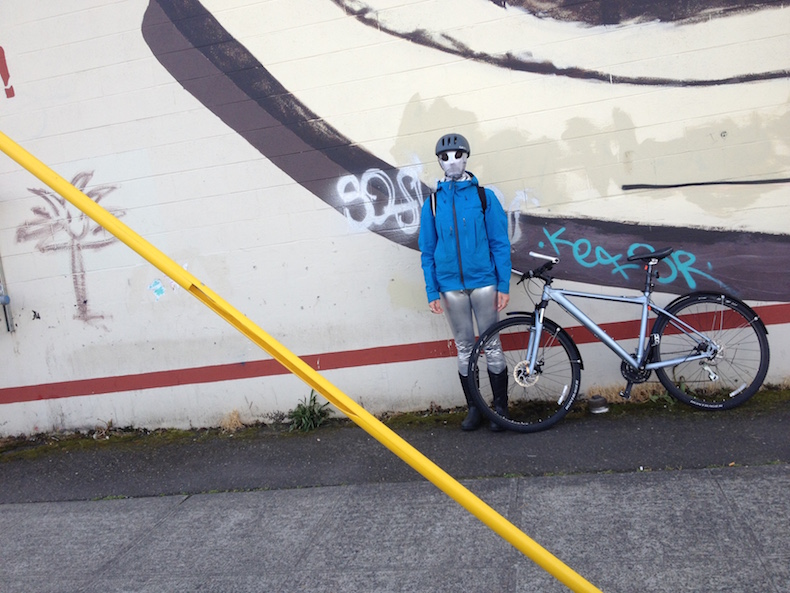
Revised alien

When I put on the metallic silver unitard and homemade alien mask that rainy morning, I had no idea that I was about to embark on one of the most stressful weekends of my life.

How could I? I love wearing costumes. One Halloween, I dressed as a vulture-like Skeksis from Jim Henson’s The Dark Crystal, and stalked through the local grocery sniffing packages of meat. Another, I made 30 little men out of fabric and baling wire, gluegunned toothpick spears into their tiny mitts, and sewed them all over my clothes. When my friends asked what I was, I screamed that I was “being attacked by tiny people!”

A mask gives you freedom to reinterpret yourself. Sort of like the way being drunk cleanses you of all your inhibitions: Maybe you dance “15,000 times better in costume than out,” as one of my friends puts it, or maybe you finally have an excuse to talk to that cute stranger dressed as a box of wine. To wear a costume is to take on a sort of power.

But the difference with my alien getup was that it wasn’t Halloween. It was an ordinary March day. As a newcomer to Portland, Oregon, I had decided to take on the role of the ultimate foreign visitor for a travel story that I was writing – a sort of cross between performance art and social experiment where I would spend 48 hours seeing the city’s sights through black, ovoid eyes. There was a tenuous journalistic angle, in that Oregon had the highest per capita rate of UFO sightings in 2014, and Portland was a hotspot. But it was personal, too: Moving from a town of 1,500 to a city of 600,000, I felt invisible. I yearned, with tinges of existential dread, to set myself apart from the faceless masses. To be a special snowflake. A special alien snowflake. Continue reading The masks we wear